Archive for the ‘Uncategorized’ Category
The Homeless, The Eighth Amendment & Judicial Limits: A Divided Ninth Circuit
It is typically prisoners who bring §1983 Eighth Amendment claims for damages and prospective relief against prison officers and officials. But what of §1983 Eighth Amendment actions brought by non-prisoners such as the homeless who allege that they are punished either because of their status—see Robinson v. California, 370 U.S. 660, 82 S. Ct. 1417, 8 L. Ed. 2d 758 (1962), or because of their involuntary acts—see Powell v. State of Tex., 392 U.S. 514, 88 S. Ct. 2145, 20 L. Ed. 2d 1254 (1968)?
The 2006 Jones Decision
After an extensive analysis of these and other Supreme Court decisions, a panel of the Ninth Circuit held seventeen years ago in a subsequently vacated opinion (the case was settled) that the Eighth Amendment prohibits the enforcement of an ordinance criminalizing sitting, lying or sleeping on public streets at all times and in all places within the city limits of Los Angeles, as applied to homeless persons between 9 p.m. and 6:30 a.m., given the unavailability of shelters in the city. The Ninth Circuit characterized the prohibited conduct as “an unavoidable consequence of being human and homeless without shelter in the City of Los Angeles.” Jones v. City of Los Angeles, 444 F.3d 1118, 1138 (9th Cir. 2006), opinion vacated, 505 F.3d 1006 (9th Cir. 2007). Judge Rymer dissented in Jones, 444 F.3d at 1138, arguing, among other things, that the Los Angeles ordinance punished conduct, not status.
The 2019 Martin Decision
Thirteen years later another panel of the Ninth Circuit, quoting Jones, reaffirmed in Martin v. City of Boise, 920 F.3d 584, 616 (9th Cir. 2019), that “the Eighth Amendment prohibits the imposition of criminal penalties for sitting, sleeping, or lying outside on public property for homeless individuals who cannot obtain shelter.” But Martin also clarified that a city is not required to provide “sufficient shelter for the homeless.”
The 2022 Johnson Decision
Then, in 2022, in Johnson v. City of Grants Pass, 50 F.4th 787 (9th Cir. 2022), amended and superseded on denial of reh’g en banc, 2023 WL 4382635 (9th Cir. 2023), yet another panel of the Ninth Circuit followed Martin and applied it to a putative class action suit brought by homeless persons successfully challenging the constitutionality of certain city anti-camping ordinances. Judge Collins dissented, 50 F.4th 787, 814, arguing that the majority’s decision was “egregiously wrong” because, even assuming Martin was still good law, the majority misread and misapplied Martin. Further, the majority disregarded class-certification principles.
Subsequently, the Ninth Circuit amended the majority’s opinion in Johnson when it denied rehearing en banc. This denial was accompanied by a dissent by Judge Collins who argued that both Martin and the decision in Johnson were wrong and should be overturned. It was further accompanied by lengthy statements of various judges defending or criticizing the denial of rehearing en banc, as well as by several opinions dissenting from the denial of rehearing en banc, including one by Judge Bress, joined by eleven other judges, which maintained that there was no Eighth Amendment violation here.
Comments
Many of the opinions in Johnson were quite spirited. This is not surprising given the divisive nature of the homelessness issue, especially in urban areas around the country. The overall flavor of the Ninth Circuit judges who disagreed on the merits with the majority in Johnson is perhaps captured by a part of Judge Bress’s opinion dissenting from denial of rehearing en banc:
“But on top of everything that our localities [including San Francisco] must now contend with, our court has injected itself into the mix by deploying the Eighth Amendment to impose sharp limits on what local governments can do about the pressing problem of homelessness …. With no mooring in the text of the Constitution, our history and traditions, or the precedent of the Supreme Court, we have taken our national founding document and used it to enact judge-made rules governing who can sit and sleep where, rules whose ill effects are felt not merely by the states and not merely by our cities, but block by block, building by building by building, doorway by doorway.”
Notice that the 2019 Martin case soundly determined that the Eighth Amendment on its own does not give rise to an affirmative duty to provide shelter to the homeless. Still, the deep issue here, in my view, is whether and to what extent §1983 Eighth Amendment litigation of this kind can realistically bring about any meaningful reforms. I suspect that, at most, it may prod legislative bodies to respond in some way. But I am skeptical that it can do much more than that. Ultimately, the remedies are political and require political will.
Chalking, Parking Tickets and the Fourth Amendment: The Ninth Circuit Disagrees
In Verdun v. City of San Diego, 51 F.4th 1033, 1035 (9th Cir. 2022), the Ninth Circuit stated:
“We are asked to decide whether the longstanding practice of chalking tires for parking enforcement purposes violates the Fourth Amendment. It does not. Even assuming the temporary dusting of chalk on a tire constitutes a Fourth Amendment ‘search,’ it falls within the administrative search exception to the warrant requirement. Complementing a broader program of traffic control, tire chalking is reasonable in its scope and manner of execution.”
The Ninth Circuit emphasized it assumed without deciding that chalking is a search. It also observed that it “respectfully” disagreed with the Sixth Circuit’s decision in Taylor v. City of Saginaw, 11 F.4th 483 (6th Cir. 2021), which took the position, among other things, that tire chalking is a search that is not subject to the administrative search exception. Consequently, according to the Sixth Circuit, chalking followed by a parking ticket violates the Fourth Amendment.
Judge Bumatay dissented, 51 F.4th at 1048, arguing that the original understanding of the Fourth Amendment demonstrates that the city’s chalking policy was both a “search” and “unreasonable.”
I discussed Taylor several years ago in a post which you may want to check out: https://nahmodlaw.com/2020/09/07/chalking-tires-parking-tickets-community-caretaking-and-the-fourth-amendment/
As noted, the Ninth Circuit here, unlike the Sixth Circuit in Taylor, did not have to decide the “search” issue because it ultimately ruled that even if chalking is a “search,” the Fourth Amendment is not violated.
Certiorari Granted in First Amendment Retaliatory Arrest Case: Gonzalez v. Trevino, No. 22-1079
The Supreme Court recently granted certiorari in Gonzalez v. Trevino, 42 F.4th 487 (5th Cir. 2022), cert granted, 143 S. Ct. — (2023), where the plaintiff, a former city council member, alleged that the individual defendants arrested her for illegally removing a government record in retaliation for the exercise of her First Amendment rights. Because the plaintiff conceded there was probable cause for the arrest, and because the plaintiff (according to the Fifth Circuit) did not introduce comparative objective evidence showing that otherwise similarly situated persons who did not engage in the same protected speech were not arrested, the Fifth Circuit affirmed the dismissal of her § 1983 First Amendment retaliation claim. She did not fit within the exception set out in Nieves v. Bartlett, 139 S. Ct. 1715 (2019): under this “narrow” exception, a First Amendment retaliatory arrest plaintiff has the opportunity to show that, even where there was probable cause to arrest, this is not a defense if the plaintiff can show through objective evidence that he or she was arrested when other similarly situated persons who did not engage in protected speech were not.
The Fifth Circuit also observed that it did not adopt what it characterized as the “more lax reading of the exception” that the Seventh Circuit purportedly articulated in Lund v. City of Rockford, Illinois, 956 F.3d 938 (7th Cir. 2020).
Judge Oldham dissented, 42 F.4th at 495, arguing that the plaintiff stated a § 1983 First Amendment retaliation claim after Nieves even though there was probable cause: Nieves did not require comparative evidence (often difficult if not impossible to obtain), only objective evidence. Moreover, in Judge Oldham’s view, the more relevant precedent was Lozman v. City of Riviera Beach, 138 S. Ct. 1945 (2018), where the plaintiff sued a city who, through its policymakers, allegedly had him arrested in retaliation for the exercise of his First Amendment rights. In Lozman, the Court ruled that the plaintiff had met his burden because he alleged an official policy or custom, which made this a very different case from those involving retaliatory arrest claims against police officers individually. In this regard, it was significant for Judge Oldham in Gonzalez that plaintiff brought her claim against individual conspirators which, as in Lozman, was very different from the typical retaliatory arrest claim.
Comments
Recall that Nieves held that a §1983 plaintiff alleging that he or she was arrested because of the exercise of First Amendment rights has the burden of pleading and proving the absence of probable cause for the arrest. I criticize Nieves in an earlier post for mangling §1983 and the First Amendment in order to protect law enforcement. See https://nahmodlaw.com/2019/06/04/nieves-v-bartlett-and-retaliatory-arrests-protecting-law-enforcement-at-the-expense-of-the-first-amendment-and-section-1983/
I also, at greater length, severely criticize Nieves and its reasoning at §3:13 of my Treatise, Civil Rights and Civil Liberties Litigation: The Law of Section 1983 (2023-24 ed.)(West/ Westlaw).
But Nieves is the law, so the Supreme Court in Gonzalez is now tasked with the need to determine what the Nieves Court meant by its “narrow” exception: what evidence is required for a §1983 First Amendment retaliatory arrest plaintiff to overcome the existence of probable cause to arrest?
My prediction is that the Court will continue to make it quite difficult for §1983 plaintiffs in such cases to prevail. It will affirm the Fifth Circuit in Gonzalez and insist on the need for comparative evidence, just as it and the circuits do in class-of-one equal protection cases. See generally §3:85 of my Treatise for discussion of Village of Willowbrook v. Olech, 120 S. Ct. 1073 (2000) and for collected circuit court decisions.
State Action, Social Media & §1983: Certiorari Granted
Important state action issues involving social media are arising with increasing frequency in the circuits. These issues typically occur in the First Amendment setting where state and local government officials block citizens from their social media. The threshold question is whether such blocking constitutes state action and thus implicates not only the First Amendment but also the possibility of §1983 damages liability. (See cases collected in Nahmod, Civil Rights and Civil Liberties Litigation: The Law of Section 1983 §2:16 (“Media, Including Social Media”)(2023-24 ed.)(West/Westlaw)).
The Supreme Court recently granted certiorari in two social media cases that came out differently on the state action question, one from the Sixth Circuit and the other from the Ninth Circuit.
Lindke v. Freed: The Sixth Circuit Decision (No State Action)
Lindke v. Freed, 37 F.4th 1199 (6th Cir. 2022), cert granted, 143 S. Ct. — (2023), involved a city manager who used his Facebook page for administrative directives and for explaining his Covid-19 policies. He also used the page to post as a father and husband. The Sixth Circuit ruled that he was not a state actor when he deleted the plaintiff’s critical comments from his page and “blocked” him as well, thereby keeping the plaintiff from commenting on the page and its posts.
The Sixth Circuit, affirming the district court’s grant of summary judgment to the defendant, found that the city manager maintained the Facebook page in his personal capacity. Under what it called its “state-official” test, which was a version of the Supreme Court’s nexus test, the Facebook page did not derive from defendant’s duties as city manager—it did not belong to the office of city manager. Further, the Facebook page did not depend on his state authority. The Sixth Circuit observed that its approach was different from that of some other circuits which focused on a page’s appearance or purpose: “[W]e focus on the actor’s official duties and use of government resources or state employees.”
Garnier v. O’Connor-Ratcliff: The Ninth Circuit Decision (State Action)
Compare Garnier v. O’Connor-Ratcliff, 41 F.4th 1158, 1163 (9th Cir. 2022), cert granted, 142 S. Ct. — (2023), where members of a school district’s board of trustees, who used social media to communicate with constituents and parents about public issues and board matters, blocked the plaintiff parents entirely from defendants’ social media pages because of the plaintiffs’ repeated criticisms of the trustees and the board. The Ninth Circuit ruled that the defendants acted under color of law.
Affirming the district court’s judgment for the plaintiffs, the Ninth Circuit declared: “[A] state official violates the First Amendment by creating a publicly accessible social media page related to his or her official duties and then blocking certain members of the public from that page because of the nature of their comments.” The Ninth Circuit reasoned that there was a clear nexus between the trustees’ use of social media and their official positions. And it commented that it was following the analysis of the Second, Fourth and Eighth Circuits in emphasizing the use of the defendants’ use of social media as “an organ official business.”
Comments
The ultimate question in all state action cases is whether the challenged nominally private conduct of a person or entity should be attributed to the state or local government. Another way of putting this is to ask whether the state or local government is responsible for the challenged conduct.
Note that there is no one state action test. In fact, there are more than a few–nexus, symbiotic relationship, public function, joint activity and entwinement–any one of which can support a finding of state action. See generally §§2:4-2:17 of my Treatise for a comprehensive discussion of state action.
In addition, the Court has repeatedly made clear that the state action inquiry must be made on a case-by-case basis. It is therefore unlikely that what the Court does in these cases will give us an generally applicable state action rule for social media.
On the other hand, consider that these particular state action cases implicate important First Amendment considerations which will surely be uppermost in the minds of the Justices and therefore likely affect the state action outcomes.
Preserving Qualified Immunity On Appeal: Dupree v. Younger Glosses Ortiz v. Jordan
Ortiz v. Jordan and Sufficiency Challenges
It is important to distinguish interlocutory appeals of denials of qualified immunity summary judgment motions from situations of the sort that arose in Ortiz v. Jordan, 562 U.S. 180, 131 S. Ct. 884, 178 L. Ed. 2d 703 (2011).
Suppose that defendants in a §1983 case raise qualified immunity on summary judgment and lose at the district court level because there are genuine issues of material fact in dispute. The defendants choose not to appeal, the case goes to trial and a jury finds for the plaintiff. Suppose further that defendants never contested the jury’s liability finding under F.R.C.P. 50(b) and also did not request a new trial under Rule 59(a). After the district court enters judgment for the plaintiff, the defendants appeal and argue that the district court should have granted their qualified immunity motion for summary judgment in the first place. May the defendants appeal the denial of their qualified immunity motion for summary judgment after the district court has held a full trial on the merits? The Court in Ortiz resolved a conflict in the circuits and unanimously answered NO.
In Ortiz, the plaintiff, a former inmate in a state reformatory, sued two superintending prison officials alleging that they violated the Eighth and Fourteenth Amendments when they failed to protect her from a second sexual assault (after she reported the first one) and also retaliated against her when she thereafter reported that she had been sexually assaulted twice by the same corrections officer. The defendants’ qualified immunity summary judgment motion was denied by the district court on the ground that there were genuine issues of material fact in dispute. Rather than appeal, the defendants proceeded to trial after unsuccessfully making motions for judgment as a matter of law under F.R.C.P. 50(a). The jury awarded $350,000 in compensatory and punitive damages against one defendant and $275,000 against the other. Defendants then appealed the district court’s order denying their qualified immunity summary judgment motion, and the Sixth Circuit reversed on the ground that the defendants were protected by qualified immunity.
The Opinions in Ortiz
The Supreme Court in turn reversed unanimously in an opinion by Justice Ginsburg. The Court explained: “The order retains its interlocutory character as simply a step along the route to final judgment.” Once there is a trial, the qualified immunity defense must be addressed “in light of the character and quality of the evidence received in court.” Even though the Sixth Circuit in this case apparently reviewed the district court’s pretrial order in light of some evidence submitted at trial, this was impermissible because the defendants’ failure to renew their motion for judgment as a matter of law under Rule 50(b) deprived the Sixth Circuit of any “warrant to reject the appraisal of the evidence” by the district court which had seen and heard the witnesses. Furthermore, the Sixth Circuit’s decision was not based on a purely legal issue pursuant to Johnson v. Jones, 515 U.S. 304, 115 S. Ct. 238 (1995): the relevant Eighth Amendment law was clearly settled at the time of the challenged conduct. Consequently, defendants’ appeal was not properly before the Sixth Circuit because it involved evidentiary sufficiency, which defendants could have raised by post-trial motion under Rule 50(b) but did not. (see generally on Johnson v. Jones, §8:9 of my Treatise, Civil Rights and Civil Liberties Litigation: The Law of Section 1983 (2023-24 ed.)(West/Westlaw))
Justice Thomas, joined by Justices Scalia and Kennedy, concurred in the judgment. 131 S. Ct. at 893. They complained that the Court should have limited its decision to the impropriety of appealing a district court’s denial of a qualified immunity summary judgment motion after a trial on the merits without getting into the effect of the defendants’ post-trial failure to renew their motion for judgment as a matter of law under Rule 50(b). In their view, this was a relatively easy case where the Court of Appeals did not have jurisdiction to review, and the Court should not have reached out to address “difficult and far-reaching questions of civil procedure.”
Comments on Ortiz
Several comments about Ortiz are appropriate. First, the Court did not rule that the defendants had waived their qualified immunity defense. Rather, had they properly used Rule 50(b), they could have renewed the question of their entitlement to qualified immunity after trial. Because they did not do so, the Sixth Circuit did not have jurisdiction over their attempt to appeal the district court’s denial of their pretrial qualified immunity summary judgment motion. Second, the Court rejected the defendants’ contention that their appeal only raised issues of law that the Sixth Circuit had jurisdiction to decide. Finally, and despite the misgivings of the concurring Justices, the Court acted appropriately in advising attorneys how to deal with qualified immunity under Rule 50(b) in situations where denials of qualified immunity summary judgment motions are not immediately appealed and §1983 damages claims against state and local government officials go to trial.
Dupree v. Younger and Purely Legal Issues
Thereafter, the Court considered the question whether the preservation requirement of Ortiz—that “a party who wants to preserve a sufficiency challenge for appeal must raise it anew in a post-trial motion”—applies “to a purely legal issue resolved at summary judgment.” In Dupree v. Younger, 143 S. Ct. – (2023), the Court answered in an opinion by Justice Barrett that it does not.
In this § 1983 Fourteenth Amendment excessive force case brought by a pretrial detainee against a corrections officer, the defendant moved for summary judgment on the ground that the plaintiff had failed to exhaust administrative remedies under the Prison Litigation Reform Act—see generally §9:65 of my Treatise. The district court denied the motion, concluding as a matter of law that there was no factual dispute that the exhaustion requirement had been satisfied. After a jury trial at which the plaintiff prevailed, the defendant did not file a post-trial motion under Rule 50(b). He instead appealed to the Fourth Circuit on one issue: the district court’s rejection of his exhaustion defense on summary judgment. The Fourth Circuit rejected the appeal on the ground that the defendant did not renew the exhaustion issue in a post-trial motion per Ortiz, even though the issue was a purely legal one.
The Opinion in Dupree
The Supreme Court unanimously reversed, ruling that Ortiz was limited to sufficiency of the evidence issues and did not extent to purely legal issues. It explained: “Fact-dependent appeals must be appraised in light of the complete trial record. … From the reviewing court’s perspective, there is no benefit to having a district court reexamine a purely legal issue after trial.” It went on to reject the defendant’s counterargument that the Court’s decision improperly created a two-track system of summary judgment. The Court responded that Rule 56 did not demand “such uniformity”: district courts sometimes deny motions for summary judgment because there are no genuine issues of material fact in dispute, while at other times they do so on purely legal grounds. Therefore, the Court’s approach distinguishing between sufficiency of the evidence issues and purely legal issues made sense. The Court then remanded to the Fourth Circuit to decide whether the exhaustion issue before it was indeed purely legal.
Health & Hospital Corp. v. Talevski: An Important Section 1983 “Laws” Decision on the Spending Power with 10th Amendment Overtones
Consider Health & Hospital Corporation of Marion County v. Talevski, 143 S. Ct. — (2023), aff’g, 6 F.4th 713 (7th Cir. 2021), an important case involving Congress’s spending power and the relationship between § 1983 and alleged violations of the Federal Nursing Home Reform Act (FNHRA), 42 U.S.C.A. §§1396r et seq.
In Talevski, the plaintiff sued a state-run nursing home facility and others under § 1983 for violations of the unnecessary-restraint and predischarge-notice provisions of the Act. Reversing the district court which had dismissed for failure to state a claim, the Seventh Circuit agreed with decisions of the Third and Ninth Circuits and ruled that violations of FNHRA are actionable under §1983. According to the Seventh Circuit, the text and structure of the Act “unambiguously reveal that it establishes individual rights for a particular class of beneficiaries.” Further, there was nothing in the Act that impliedly foreclosed §1983 claims.
The Questions Presented On Certiorari
On certiorari review, the Supreme Court addressed the following Questions Presented: “(1) Whether, in light of compelling historical evidence to the contrary, the Court should reexamine its holding that spending clause legislation gives rise to privately enforceable rights under 42 U.S.C. §1983; and (2) whether, assuming spending clause statutes ever give rise to private rights enforceable via Section 1983, the Federal Nursing Home Amendments Act of 1987’s transfer and medication rules do so.” It was the first Question Presented in particular that attracted the Court’s attention and that of many observers, including me.
The Majority Opinion
In an opinion by Justice Jackson, the Supreme Court affirmed the Seventh Circuit. It rejected the broad defense argument that the “laws” language of § 1983 does not include federal statutes such as FNHRA that were enacted pursuant to Congress’s spending power. The Court declared: “’Laws’ means ‘laws,’ and nothing in [defendants’] appeal to Reconstruction-era contract law shows otherwise.” It strongly disagreed with the defense contention that because the FNHRA was enacted under the spending power and bound states through their agreements to participate, it was analogous to a contract “which was not ‘generally’ enforceable by third party beneficiaries at common law.” For one thing, it is not so clear that this was in fact the common law of contracts in 1871. For another, § 1983 claims are analogous to torts, not contracts. The Court emphasized that it relied on § 1983’s text and history, as well as its precedents, for its conclusion that there is no § 1983 “carve out” for federal legislation enacted under the spending power.
Next, the Court addressed the specifics of FNHRA’s statutory language. It determined that the two relevant provisions of the Act unambiguously created enforceable rights, in “stark contrast to the statutory provisions that failed Gonzaga’s test in Gonzaga itself.”
Finally, the Court concluded that there was no incompatibility between the Act’s remedial scheme and private § 1983 enforcement of the unnecessary-restraint and predischarge-notice.provisions of the Act. The Court, applying the approach of City of Rancho Palos Verdes, then observed that there was nothing in the Act that would indicate “implicit preclusion” of a § 1983 remedy or that would suggest that allowing a § 1983 remedy would “thwart” the Congressional purpose in enacting the Act. Along these lines, it was significant that the Act included a provision that stated that the Act’s remedies were “in addition to those otherwise available under State or Federal law and shall not be construed as limiting such other remedies.”
The Three Concurring Justices: Justices Gorsuch, Barrett and the Chief
Justice Gorsuch concurred, observing that the defendants failed to “develop fully” any arguments revolving around whether federal statutory rights in spending power legislation were “secured consistent with the Constitution’s anti-commandeering principle.”[1] Justice Barratt, joined by Chief Justice Roberts, also concurred, emphasizing that an “actual clash—between one private judicial remedy against another, more expansive remedy—is not required to find that a statute forecloses recourse to § 1983.”
The Two Dissenting Justices: Justices Thomas and Alito
Justice Thomas dissented at great length. He argued that there was a difference in kind between federal legislation enacted under Congress’s enumerated powers and those enacted under the so-called “spending power.” The latter were not “laws” within the meaning of § 1983’s language. They were contractual in nature and could not “secure rights by law.” Furthermore, to the extent that such federal statutes might by enforced through § 1983, they ran “headlong into the anticommandeering doctrine and long-recognized limitations on the federal spending power.”
Justice Alito, joined by Justice Thomas, also dissented. He argued that while the FNHRA created individual rights, Congress had not indicated its intent to allow § 1983 to be used to enforce the relevant provisions of the Act. To the contrary: “Allowing § 1983 suits will upend [the Act’s] careful balance” of federal and state enforcement that “channels disputes through that regime.”
Comments
In Talevski, § 1983 claims based on violations of federal statutes enacted under the spending power dodged a bullet: these kinds of claims might have been eliminated entirely. Still, even though they are still viable, it is fair to say that going forward, such claims will continue to be viewed from a posture of skepticism by a number of the justices because of concerns with the scope of Congressional power, anti-commandeering and federalism.
It is also worth noting that several justices in Talevski appear to have found a unique way around the broad scope of §1983 by focusing on the word “secured” in the statute and then giving it a crabbed interpretation. This reminds me of the Court’s disingeneous ruling earlier in the Term in Vega v. Tekoh, 142 S. Ct. — (2022), that Miranda rights are not “secured by the Constitution.” I call it “disingenuous” because in my view it can only be explained by an implicit rejection of Miranda. See my post: https://nahmodlaw.com/2022/07/12/miranda-violations-and-section-1983-the-disingenuous-decision-in-vega-v-tekoh/
I discuss “laws” actions, including those based on federal spending power legislation, extensively in Chapter 2 of my Treatise, Civil Rights and Civil Liberties Litigation: The Law of Section 1983 (2022-23 ed.)(West/Westlaw).
I invite you to follow me on Twitter: @NahmodLaw
Section 1983, Proximate Cause And The Ninth Circuit’s “Integral Participant” Doctrine
In Peck v. Montoya, 51 F.4th 877 (9th Cir. 2022), the five officer defendants responded to a 911 call that decedent was acting erratically and threatening another person with a firearm. Two of those officers in this § 1983 Fourth Amendment excessive force case then shot and killed the decedent.
After affirming the district court’s denial of qualified immunity to the two shooting officers, the Ninth Circuit went on to consider whether the other three officers could also be liable for the killing, and therefore similarly not entitled to qualified immunity, on the ground that they were “integral participants” in the two officers’ use of excessive force.
The court, in an opinion that discussed both cause in fact and proximate cause, rejected the argument that cause in fact involvement is enough to render the three officers “integral participants”: this, without any relation to state of mind, would subject to liability anyone who had a causal relationship with the killing, including the 911 dispatcher and “even the mechanic who fixed [defendants’] cars….”
Instead, there is a kind of proximate cause requirement for integral participation as well: (1) the defendant must know or have acquiesced in the unconstitutional conduct as part of a common plan or (2) the defendant must have set into motion a series of acts by others that the defendant knew or should have known would bring about the constitutional deprivation.
In this case, the evidence was clear that the three officers were not integral participants: the shooting was unplanned and they had no reason to think that their providing of armed backup would enable the later unconstitutional use of force by the two officers. Any other result would not only be inconsistent with the approach rejected by the Supreme Court in County of Los Angeles v. Mendez, 137 S. Ct. 1539 (2017), but would effectively result in strict liability. “That is not the law.”
But I wonder about the utility of this so-called “integral participant” doctrine and what it adds to the analysis. The result in Peck can be readily justified without recourse to such a doctrine: by simply pointing out that individual liability under § 1983 for a Fourth Amendment violation requires an intent to seize. Here, even though there was a seizure committed by the two shooting officers and proof of a cause in fact connection between the conduct of the three officers and the plaintiff’s Fourth Amendment deprivation, there was apparently no proof of such intent on the part of these three officers. Sometimes less is more.
Recall that I posted on Mendez and proximate cause here: https://nahmodlaw.com/2017/06/16/county-of-los-angeles-v-mendez-supreme-court-rejects-provocation-rule-remands-on-proximate-cause/.
I also discuss Mendez at some length in Chapter 3 of my Treatise, Civil Rights and Civil Liberties Litigation: The Law of Section 1983 (2022-23 ed.; West & Westlaw).
I can be followed on Twitter @NahmodLaw.
Reed v. Goertz: A New Supreme Court §1983 Accrual Decision
In a much-read post on statutes of limitation and §1983, I discuss the important principle that §1983 accrual rules are matters of federal law. (See https://nahmodlaw.com/2011/10/27/a-section-1983-primer-5-statutes-of-limitations/).
In related subsequent posts and in my Treatise, I address the special accrual rule of Heck v. Humphrey, 512 U.S. 477 (1994), where the plaintiff has a prior conviction whose validity might be implicated by a successful §1983 action; Wallace v. Kato, 127 S. Ct. 1091 (2007), the accrual of §1983 Fourth Amendment false arrest claims; McDonough v. Smith, 139 S. Ct. 2149 (2019), the accrual of §1983 fabrication of evidence claims; and Thompson v. Clark, 142 S. Ct. 1332 (2022), accrual on favorable termination of §1983 Fourth Amendment “malicious prosecution” claims. See Chapter 9 in Nahmod, CIVIL RIGHTS AND CIVIL LIBERTIES LITIGATION: THE LAW OF SECTION 1983 (2022-23 ed.)(West/Westlaw).
Now comes Reed v. Goertz, 143 S. Ct. — (April 19, 2023), reversing, 995 F.3d 425 (5th Cir. 2021), where the plaintiff inmate, sentenced to death for murder, sued state officials for prospective relief under §1983 alleging that, in violation of procedural due process, he was denied access to physical evidence that he wanted to test for DNA, Ruling that this claim, filed in August 2019, was time-barred under the applicable two-year Texas personal injury statute of limitations, the Fifth Circuit found that the plaintiff first became aware that his rights were possibly being violated when a trial court denied his motion for post-conviction relief regarding DNA testing in November 2014. At that time, he had all of the relevant information he needed and, moreover, was not required under §1983 to exhaust judicial remedies. Thus, under the discovery rule, he knew or should have known of his alleged injury five years before he sued. The Fifth Circuit rejected the plaintiff’s argument that his cause of action accrued in October 2017 when, following appeal of the trial court’s denial of his motion and the Texas Court of Criminal Appeals’ affirmance of that denial, it denied rehearing in October 2017.
The Supreme Court, agreeing with the plaintiff, reversed in an opinion by Justice Kavanaugh and found the plaintiff’s §1983 claim timely. It determined that because the plaintiff’s §1983 claim sounded in procedural due process, that denial of procedural due process was only complete in October 2017, when the Texas Court of Appeal denied rehearing. It was only at this time that the state court litigation effectively ended.
Justice Thomas dissented, arguing that the district did not have subject matter jurisdiction in the first place, including under the rationale of the Rooker-Feldman doctrine, because the plaintiff was really seeking review of the Texas Court of Appeals decision. Justice Alito, joined by Justice Gorsuch, also dissented, contending that the plaintiff’s §1983 procedural due process claim accrued when the Texas Court of Criminal Appeals affirmed the trial court on April 12, 2017, and not later when it denied plaintiff’s motion for rehearing.
Commentary
It is crucial in §1983 accrual cases to understand just what the question is: when are all the elements of the claim present? Since this claim is federal, it is understandable that accrual of §1983 claims must be a matter of federal law.
It is also essential in §1983 accrual cases to identify just what the constitutional basis for the claim is. Or to put it another way, what precisely is the plaintiff challenging? In Reed it is the denial of procedural due process, and this was determinative for the majority of just when the plaintiff’s claim accrued. In other situations, such as those involving §1983 Fourth Amendment arrest claims, the accrual rule is different. See Wallace. Or in still other situations, such as fabrication of evidence and Fourth Amendment malicious prosecution, the accrual rule is again different. See McDonough and Thompson.
From that perspective, Reed is a narrow decision applicable to the relatively few cases involving §1983 procedural (not substantive) due process prospective relief challenges by convicted persons to government refusals to provide possibly exonerating evidence. But the Court’s general approach is consistent with its approach in other §1983 accrual cases.
One more observation: it is notable how Justice Thomas (gratuitously?) raises a host of subject matter jurisdiction issues–Article III standing and justiciability in general, as well as Rooker-Feldman–that the majority gives such sort shrift to.
The Intriguing Intersection of DeShaney and Monell Liability: The Seventh Circuit’s LaPorta Decision
In First Midwest Bank Guardian of Estate of LaPorta v. City of Chicago, 988 F.3d 978, 990–91 (7th Cir. 2021), cert. denied, 142 S. Ct. 389, 211 L. Ed. 2d 207 (2021), the Seventh Circuit put DeShaney v. County of Winnebago, 489 U.S. 189 (1989), to unusual use in ruling against the guardian of an individual who was shot by his friend, an off-duty police officer not acting under color of law at the time. (Full disclosure: I played a consulting role for the plaintiff’s law firm)
The guardian claimed that the City of Chicago “had inadequate policies in place to prevent the shooting—or more precisely, that the City’s policy failures caused [the officer] to shoot him.” Specifically, he alleged: the failure to have an “early warning system” for officers likely to engage in misconduct; the failure to investigate and discipline officers for their misconduct; and the “perpetuation” of a code of silence that deterred reporting of such officers. All of this rendered the City liable under Monell v. Dept. of Social Services, 439 U.S. 974 (1978).
Reversing the jury’s compensatory damages award of $44.7 million (!) against the city, the Seventh Circuit declared that the guardian lost on its §1983 substantive due process bodily integrity claim under DeShaney because the guardian was asserting that the city had an affirmative duty to protect the individual from harm. The DeShaney exceptions did not apply. First, there was no special relationship since the individual was not in state custody. And second, the “narrow” state created danger doctrine, which required more than a “generalized risk of indefinite duration and degree,” did not apply because there was no evidence that the city affirmatively placed the individual in danger. Further, according to the Seventh Circuit, the guardian never explicitly raised the state created danger exception, and the jury was never instructed on it.
Finally, the Seventh Circuit rejected the guardian’s argument that DeShaney was inapplicable and that, instead, Monell supported liability inasmuch as the jury found that the city’s policy failures “caused” the officer to shoot the individual. This argument “reflect[ed] a basic misunderstanding of the relationship between Monell and DeShaney. [These cases] are not competing frameworks for liability. The two cases concern fundamentally distinct subjects.” Monell dealt with §1983 interpretation and local government liability, while DeShaney dealt with the constitutional issue of substantive due process. The Seventh Circuit thus concluded that the individual’s constitutional rights were not violated because the city had no affirmative due process duty to protect the individual from the officer’s “private violence.”
Comments
1. Had the police officer here acted under color of law, the DeShaney issue would have disappeared to the extent that DeShaney only applies to the prevention by government of privately caused harm. The issues then would have been, first, whether the police officer’s conduct constituted a substantive due process violation and second, if so, whether the City’s policies caused that substantive due process deprivation. If either question were to be answered in the negative, then the City would not be liable.
2. I have posted regularly about tragic DeShaney cases in the circuits. (You can search “DeShaney” on this blog for many examples) But LaPorta is unusual in that it sharply distinguished between the constitutional interpretation issue posed and the Monell liability issue, a matter of statutory interpretation. This distinction is, of course, sound so far as it goes.
But LaPorta might have come out the other way had the Seventh Circuit found that the challenged conduct–the alleged policies of the City, which were clearly state action–caused the violation of the individual’s substantive due process rights because those policies created the danger to him. The argument is that the City’s policies effectively placed the gun in the off-duty officer’s hand. This the Seventh Circuit did not do because under its approach any state created danger was not sufficiently particularized. The Seventh Circuit also commented that the plaintiff had never explicitly raised the issue. Thus, DeShaney controlled: there was no substantive due process violation.
3. On DeShaney, substantive due process affirmative duties and cases raising those issues, see Nahmod, Civil Rights & Civil Liberties Litigation: The Law of Section 1983 §§ 3:59-3:61 (2022-23 ed. West/Westlaw).
Save the Dates: Annual Section 1983 Conference (In-Person) on April 27-28, 2023
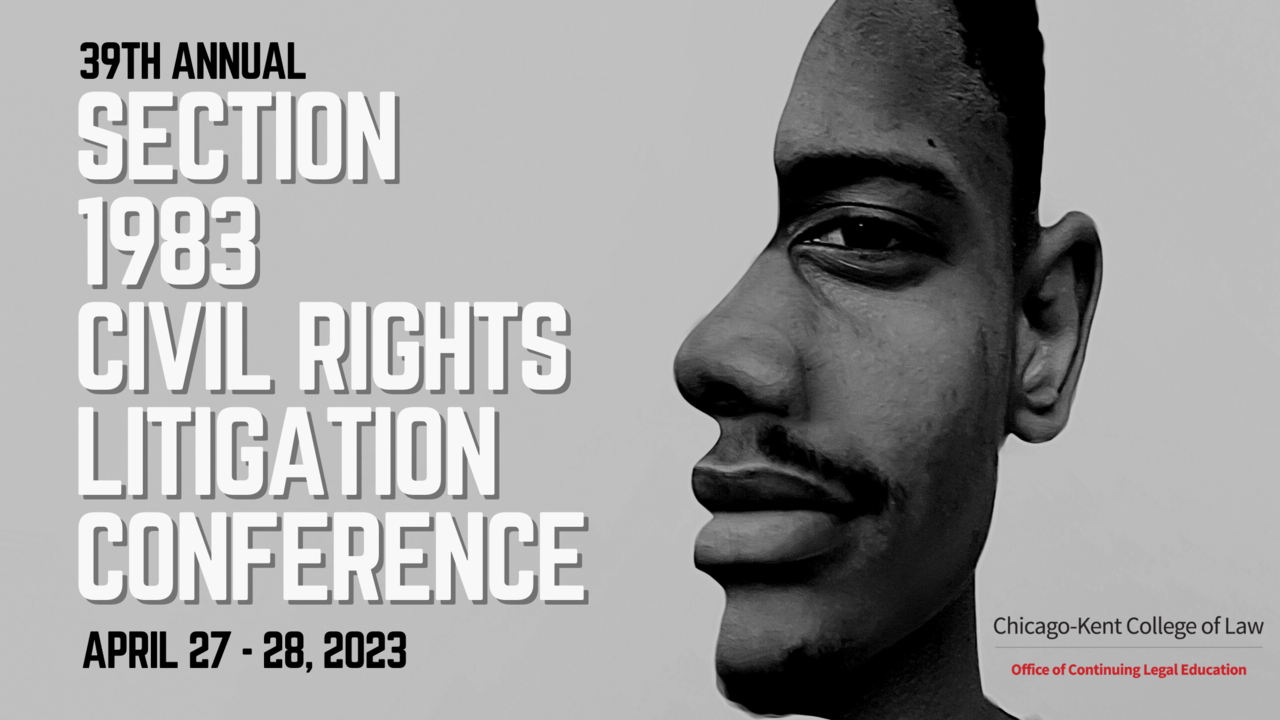 SAVE THE DATE SAVE THE DATEApril 27 – 28, 2023 Chicago-Kent College of Law 565 W. Adams Street Chicago, IL 60661 Eligible for IL MCLE Credit Liability arising out of §1983 claims continues to present challenges for courts across the country, and the Supreme Court has a large impact in this dynamic area of law. Join us for this two-day in-person conference to get up-to-date on the latest cases, trends, and strategies affecting §1983 litigation. You have the opportunity to examine both the law of §1983 as well as the litigation strategies that underlie successful cases. Experts in the field address the most important issues and provide wisdom for you as you tackle this year’s cases, whether you represent plaintiffs or defendants. As always, the conference provides an analytical approach to problems and offers practical advice about how to solve them. SPEAKERS Gerald M. Birnberg, Founding Partner, Williams, Birnberg & Andersen LLP Karen M. Blum, Professor Emerita and Research Professor of Law, Suffolk University Law School Erwin Chemerinsky, Dean and Jesse H. Choper, Distinguished Professor of Law, University of California Berkeley School of Law Jamie S. Franklin, Assistant Clinical Professor of Law and Supervisor of Litigation Clinic, Chicago-Kent College of Law Rosalie B. Levinson, Professor of Law Emerita, Valparaiso University School of Law Sheldon H. Nahmod, University Distinguished Professor of Law Emeritus, Chicago-Kent College of Law (Program Chair) Noah Smith-Drelich, Assistant Professor of Law, Chicago-Kent College of Law This conference is in-person ONLY and will not be live-streamed. UPCOMING CLE CONFERENCES March 3, 2023 The Effect of Dobbs on Work Law Symposium March 28, 2023 44th Annual Kenneth M. Piper Lecture ON DEMAND LIBRARY 40th Annual Federal Sector Labor Relations + Labor Law Conference The Vaccine Injury Compensation Program 43rd Annual Kenneth M. Piper Lecture 38th Annual Section 1983 Civil Rights Litigation Conference Dobbs v. Jackson Women’s Health Organization Panel Never Again? Investigating and Prosecuting War Crimes: Then and Now |
| Chicago-Kent College of Law, CLE Department 565 W. Adams Street, Chicago, IL 60661 cle@kentlaw.iit.edu 1-312.906.5090 |
I hope to see many of you in Chicago for this in-person conference, together with our excellent and experienced speakers. If you have any questions, please feel free to contact the CLE department or me personally via email: snahmod@kentlaw.edu.
I invite you to follow me on Twitter @NahmodLaw.


