Archive for January 2023
Save the Dates: Annual Section 1983 Conference (In-Person) on April 27-28, 2023
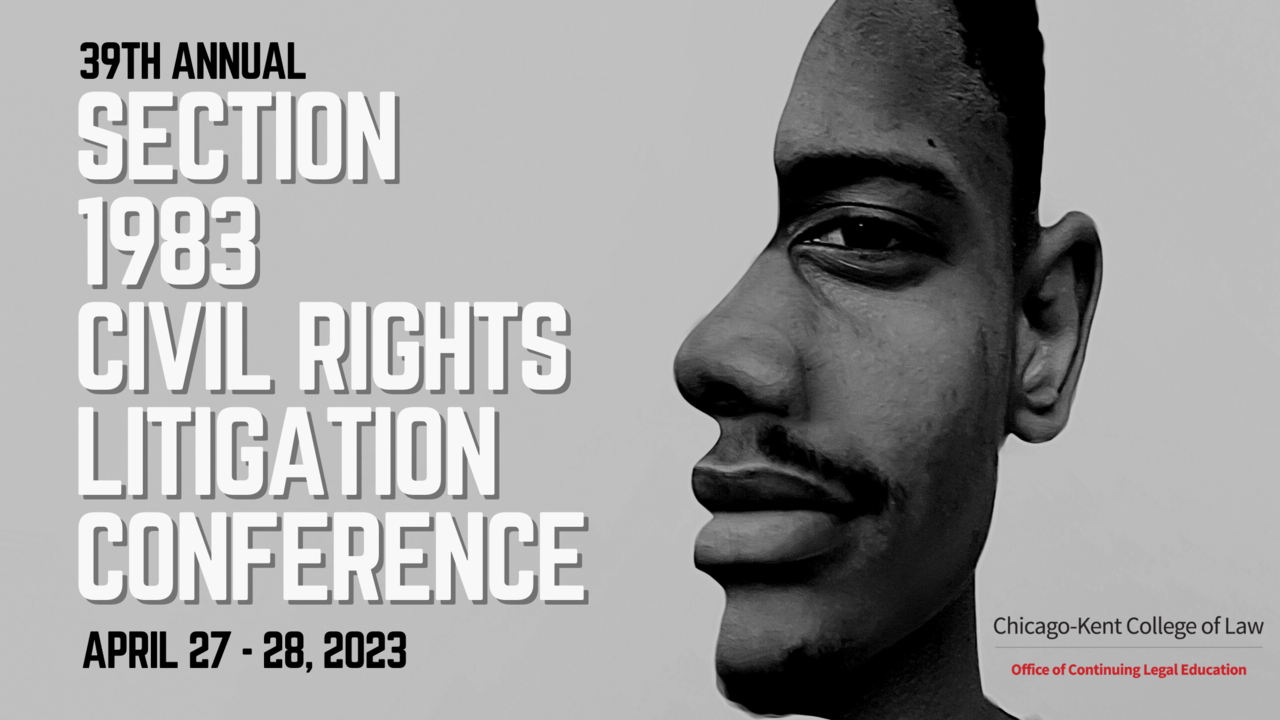 SAVE THE DATE SAVE THE DATEApril 27 – 28, 2023 Chicago-Kent College of Law 565 W. Adams Street Chicago, IL 60661 Eligible for IL MCLE Credit Liability arising out of §1983 claims continues to present challenges for courts across the country, and the Supreme Court has a large impact in this dynamic area of law. Join us for this two-day in-person conference to get up-to-date on the latest cases, trends, and strategies affecting §1983 litigation. You have the opportunity to examine both the law of §1983 as well as the litigation strategies that underlie successful cases. Experts in the field address the most important issues and provide wisdom for you as you tackle this year’s cases, whether you represent plaintiffs or defendants. As always, the conference provides an analytical approach to problems and offers practical advice about how to solve them. SPEAKERS Gerald M. Birnberg, Founding Partner, Williams, Birnberg & Andersen LLP Karen M. Blum, Professor Emerita and Research Professor of Law, Suffolk University Law School Erwin Chemerinsky, Dean and Jesse H. Choper, Distinguished Professor of Law, University of California Berkeley School of Law Jamie S. Franklin, Assistant Clinical Professor of Law and Supervisor of Litigation Clinic, Chicago-Kent College of Law Rosalie B. Levinson, Professor of Law Emerita, Valparaiso University School of Law Sheldon H. Nahmod, University Distinguished Professor of Law Emeritus, Chicago-Kent College of Law (Program Chair) Noah Smith-Drelich, Assistant Professor of Law, Chicago-Kent College of Law This conference is in-person ONLY and will not be live-streamed. UPCOMING CLE CONFERENCES March 3, 2023 The Effect of Dobbs on Work Law Symposium March 28, 2023 44th Annual Kenneth M. Piper Lecture ON DEMAND LIBRARY 40th Annual Federal Sector Labor Relations + Labor Law Conference The Vaccine Injury Compensation Program 43rd Annual Kenneth M. Piper Lecture 38th Annual Section 1983 Civil Rights Litigation Conference Dobbs v. Jackson Women’s Health Organization Panel Never Again? Investigating and Prosecuting War Crimes: Then and Now |
| Chicago-Kent College of Law, CLE Department 565 W. Adams Street, Chicago, IL 60661 cle@kentlaw.iit.edu 1-312.906.5090 |
I hope to see many of you in Chicago for this in-person conference, together with our excellent and experienced speakers. If you have any questions, please feel free to contact the CLE department or me personally via email: snahmod@kentlaw.edu.
I invite you to follow me on Twitter @NahmodLaw.
A Student Drowns While On A Field Trip: The Separate State of Mind Hurdle in Substantive Due Process Affirmative Duty Cases
I have posted (too?) many times over the years on DeShaney substantive due process affirmative duty cases, emphasizing all the while that the threshold issue in such cases is whether there is an affirmative substantive due process duty to begin with.
Typically, the answer in these tragic cases is “no”–there is generally no constitutional duty to protect citizens from private harm–unless there is a special relationship or the state has created the danger. DeShaney v. Winnebago County, 489 U.S. 189 (1989). See generally on DeShaney and its progeny, NAHMOD, CIVIL RIGHTS AND CIVIL LIBERTIES LITIGATION: THE LAW OF SECTION 1983 secs. 9:59-9:61 (2022-23 ed.)(West/Westlaw).
But even where a section 1983 plaintiff is able to overcome the duty issue by, say, plausibly alleging that the state created the danger, that plaintiff may still lose because of the substantive due process state of mind requirement of at least deliberate indifference. As an example, consider Herrera v. Los Angeles Unified School Dist., 18 F.4th 1156 (9th Cir. 2021).
In Herrera, an autistic high school student drowned while on a field trip. His parents brought a section1983 substantive due process claim against various school defendants, all of whom were granted summary judgment by the district court. Finding that there was a state-created danger but still affirming, the Ninth Circuit pointed out that a school aide who was generally watching the student in the pool saw the student exit the shallow end of the pool and enter the locker room area, but he did not see the student shortly thereafter return to the pool and then drown.
The Ninth Circuit explained: “’[W]e have continued to apply the subjective standard in all state-created danger claims and in non-detainee failure-to-protect claims like the one presented here.” Because there was no genuine issue of fact in dispute that the school aide was subjectively unaware of any immediate danger to the student, the school aide was not deliberately indifferent, as required for a substantive due process failure to protect claim. Also, because other lifeguards were monitoring the area as well, the school aide did not abandon the student or leave him completely without protection. This too showed that the school aide did not act with deliberate indifference.
Comment
The Ninth Circuit applied a subjective deliberate indifference standard and not an objective one. It rejected the plaintiff’s argument that the student’s situation was analogous to that of the pretrial detainee in Kingsley v. Hendrickson, 576 U.S. 389 (2015), which applied an objective reasonableness standard to the pretrial detainee’s section 1983 substantive due process excessive force claim.
I invite you to follow me on Twitter: @NahmodLaw.
A Unique High-Speed Police Pursuit Case: The Plaintiff Might Win Against The Officer And City
High-speed police pursuit cases often end in serious bodily harm or death not only to the person pursued but to innocent bystanders as well. In most such cases the Fourth Amendment’s excessive force/reasonableness standard does not apply because there is no intentional seizure. Instead, as the Supreme Court held in the seminal decision in County of Sacramento v. Lewis, 523 U.S. 833 (19098), substantive due process applies and the appropriate standard is ordinarily “purpose to do harm,” and not the usual substantive due process standard of deliberate indifference.
This high standard serves at least two purposes: (1) it reflects the fact that these situations involve split-second decision making with no real opportunity to deliberate and (2) it serves a gatekeeper function in keeping such tort-like cases out of the federal. (This is one example of variable constitutional states of mind. Another is the Eighth Amendment)
The Seventh Circuit’s Flores Decision
Now consider Flores v. City of South Bend, 997 F.3d 725 (7th Cir. 2021). “Erica Flores’s life came to an untimely end when Officer Justin Gorny of the South Bend, Indiana, police department careened through residential streets and a red light at speeds up to 98 mph to reach a routine traffic stop he was not invited to aid, crashed into Flores’s car, and killed her.”
The Officer’s Potential Liability Under Substantive Due Process
Here, according to the Seventh Circuit, the decedent’s estate plausibly stated a substantive due process claim against the officer individually and the city for failure to train. The court, citing County of Sacramento, observed that “[i]dentical behavior considered reasonable in an emergency situation might be criminally reckless when state actors have time to appreciate the effects of their actions.” Ruling that deliberate indifference applied here, and not purpose to do harm, since the officer had the opportunity to deliberate, the court then went on to find that the officer’s “reckless conduct, unjustified by any emergency or even an order to assist in a routine traffic stop that five officers had under control, allows the inference that he subjectively knew about the risk he created and consciously disregarded it.” This constituted the requisite criminal recklessness for his liability. “The law does not provide a shield against constitutional violations for state actors who consciously take extreme and obvious risks.”
The City’s Potential Liability for Failure to Train
As to the city’s liability under a failure to train theory–see City of Canton v. Harris, 489 U.S. 378 (1989)–the decedent’s estate also plausibly alleged that the city acted with deliberate indifference because it failed to address the “known recklessness” of its police officers as a group and of the officer here. This was not a “one-free- bite” situation just because the defendant had never killed anyone before. The Seventh Circuit observed: “Notably, failure-to-train liability does not require proof of widespread constitutional violations before that failure becomes actionable; a single violation can suffice where a violation occurs and the plaintiff asserts a recurring, obvious risk.” According to the Seventh Circuit, this principle was not inconsistent with Supreme Court failure to train precedent even though the Court had not yet expressly so held.
Comments
Flores demonstrates the importance of determining at the outset in a substantive due process case like this one whether the high-speed pursuit involved the need for quick decision making by police. If it did, then the purpose to do harm standard, virtually impossible to meet in most cases, applies. In this case, though, the officer deliberately insinuated himself into the situation which turned tragic because of his involvement, thereby triggering, according to the Seventh Circuit, the deliberate indifference standard for individual liability, a much easier standard to meet. See, on substantive due process, ch. 3 of Nahmod, Civil Rights and Civil Liberties Litigation: The Law of Section 1983 (2022-23 Ed)(West/Westlaw)
As to the city’s potential liability for failure to train, note that the Seventh Circuit acknowledged that in its view–not yet approved by the Supreme Court, and the subject of disagreement in the circuits–a single violation is enough for such liability where there is a recurring and obvious risk even in the absence of a showing of widespread constitutional violations. See, on failure to train liability, ch. 6 of my Treatise.
Follow me on Twitter: @NahmodLaw
Happy New Year to you and your family.

 Nahmod Law